Instructor:
Dr. Molly Mollica (Mollica Lab)
Course Description:
Introduction to Engineering Design with CAD (ENME 204) is a sophomore-level course that introduces the engineering design process and computer-aided design. In this course, students work in teams to identify a challenge in accessible play and design a solution that is more accessible to users with disabilities.
Student Work Sample #1 (Spring 2024)
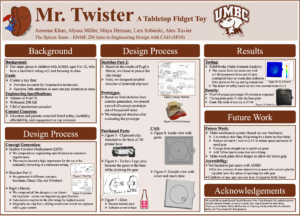
Mr. Twister: A Tabletop Fidget Toy
Ameena Khan, Alyssa Miller, Maya Herman, Lars Sobieski, Alex Xavier
The Spleen Team – ENME 204 Intro to Engineering Design with CAD (Spring 20204)
Background
- Our target group is children with ADHD, ages 8 to 12, who have a hard time sitting still and focusing in class
Goals
Create a toy that
- Provides and outlet for hyperactive tendencies
- Requires little attention so user can pay attention in class
Engineering Specifications
- Volume of 8 cubic inches
- Withstand 20 ft fall
- 5 lbf of mechanism actuation
Contact Concerns
- Educators and parents consulted listed safety, durability, affordability, and engagement as top concerns
Design Process
Concept Generation
- Quality Function Deployment (QFD)
- We compared our engineering specifications to customers requirements
- The results showed a high importance for the toy to be minimally distracting in a classroom setting
- Figure 1: The Clip
- Sketches Part 1:
- We generated 4 different concepts: Keychain, Clamp, Clip, and Wristband
- Figure 2: The Keychain
- Pugh’s Matrix
- We compared all the designs to our datum – the keychain – across out engineering specifications
- Calculations resulted in the clip being the highest scored
- Originally Out clip had a sliding mechanism which we replaced with a gear system
Sketches Part 2:
- Based on the results of Pugh’s Matrix we chose to pursue the clip design
- Next, we designed detailed sketches of potential clip toys
- Figure 3: Design sketches
Prototypes:
- Based on final sketches from concept generation, we created a proof on concept prototype out of household items
- We redesigned sketches after evaluating the prototype
- Figure 4: Proof-of-concept
Purchased Parts
- Figure 5 – Clipboard clip: Attached to the back of 3D printed base
- Figure 6 – Technic Lego pins: Secures the gears to the base while allowing for gear
- Figure 7 – Glue
- Secures technic pins
- Adheres cover to base
CAD
- Figure 8: Inside view with gears
- Figure 9: Outside view with cover and touch plate
Results
Testing
- SolidWorks Finite Element Analysis
- The results from the stress test with a 5 lbf downward force and 50 rpm centripetal force on touch plate indicates little stress on the toy during normal use
- The factor of safety based on this max normal stress is 1.1
Results
- Proof of product prototype 3D printed as expected
- The top plate press-fit into the base plate
- Cost: The total of one toy is $7.44
Future Work
- Make mechanism quieter (based on user feedback)
- Use method other than 3D printing for a better surface finish
- Reduce current 4:1 ratio to 2.5:1 to reduce speed and noise of small gear
- Change from straight-cut to spiral-cut gears
- Add Teflon tape to areas that are rubbing
- Make touch plate divot deeper to allow for better grip
Accessibility
- Not limited to just users with ADHD
- Has two avenues of user interaction so users who cannot spin the top plate have the option of spinning the side gear
- Children of any age can use it as it requires little force
Acknowledgements
We would like to thank Special Needs Educators: Mrs. Greta Sobieski, Ms. Isabella Herman, and Mrs. Jennifer Wunder, as well as a parent, Mrs. Amy Pimentel for their advice. Thank you to Professor Molly Mollica and our Teaching Assistants Ben Brooks, Brandon Spillis, and T’ana Joseph for their guidance.
Student Work Sample #2 (Spring 2024)
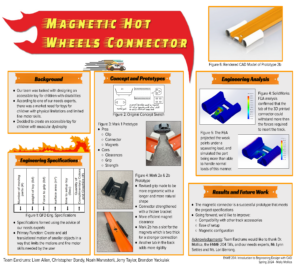
Magnetic Hot Wheels Connector
Background
- Our team was tasked with designing an accessible toy for children with disabilities
- According to one of our needs experts, there was a market need for toys for children with physical limitations and limited fine motor skills.
- Decided to create an accessible toy for children with muscular dystrophy
Engineering Specifications
- Figure 1: QFD Eng. Specifications
- Number of moving parts: minimize
- Weight of toy: minimize
- Force to grip: minimize
- Surface area: maximize
- Time to setup toy: minimize
- Quantity of complimentary colors and graphics: maximize
- Specifications formed using the advice of our needs experts
- Primary function: Create and aid translational motion of smaller objects in a way that limits the motions and fine motor skills needed by the user
Concept and Prototypes
Figure 2: Original Concept sketch – An abstract sketch of a toy car track and attachments
Figure 3: Mark 1 Prototype – A picture of two segments of toy car track each with an magnet attachment
- Pros
- Clip
- Connector
- Magnets
- Cons
- Clearances
- Grip
- Strength
Figure 4: Mark 2a & 2b Prototype
- Revised grip made to be more ergonomic with a longer and more natural shape
- Connector strengthened with a thicker bracket
- More efficient magnet clearance
- Mark 2b has a slot for the magnets with is too thick for a stronger connection
- Another tab in the back adds more rigidity
Engineering Analysis
Figure 4: SolidWorks FEA analysis confirmed that the tab of the 3D printed connector could withstand more than the forces required to insert the track
Figure 5: The FEA projected the weak points under a squeezing load, and simulated the part being more than able to handle normal loads of this manner
Figure 6: Rendered CAD Model of Prototype 2b
Results and Future Work
- The magnetic connector is a successful prototype that meets the project specifications
- Going forward, we’d like to improve:
- Compatibility with other track accessories
- Ease of setup
- Magnetic configuration
Acknowledgements: Team Eardrums would like to thank Dr. Mollica, the ENME 204 TA’s, and our needs experts, Mr. Lynn Settles and Ms. Lori Berrong.
Team Eardrums: Liam Allan, Christopher Bondy, Noah Manasterli, Jerry Taylor, Brandon Yackulak
Student Work Sample #3 (Spring 2024)
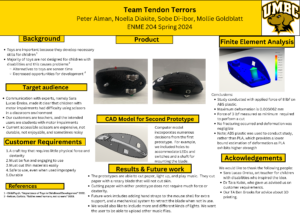
Team Tendon Terrors
Peter Alman, Noella Diakite, Sobe Di-ibor, Mollie Goldblatt
ENME 204 Spring 2024
Background
- Toys are important because they develop necessary skills for children (ChildPhsych)
- Majority of toys are not designed for children with disabilities and this causes problems (Nelson)
- Alternatives to toys are screen time
- Decreased opportunities for development
Target Audience
- Communication with experts, namely Sara Lucas-Dreiss, made it clear that children with motor impairments had difficulty using scissors in a classroom environment
- Our customers are teachers, and the intended users are students with motor impairments
- Current accessible scissors are expensive, not durable, not enjoyable, and sometimes noisy
Customer Requirements
- A craft you that requires little physical force and dexterity
- Must be fun and engaging to use
- Must cut thin materials easily
- Safe to use, even when used improperly
- Durable
Product
Two images of computer mouse-shaped body with attached wheels and a blade
CAD Model for Second Prototype
Computer model of computer mouse-shaped housing
Computer model incorporates numerous decisions from the first prototype. For example, we included holes to accommodate LEDs and switches and a shaft for mounting the blade.
Finite Element Analysis
Conclusions
- Study conducted with applied force of 8 lbf on ABS plastic
- Maximum deformation is 0.005062 mm
- Force of 3 lbf measured as minimum required to perform a cut
- No fracturing occurred and deformation was negiligible
- Note; ABS plastic was used to conduct study, rather than PLA, which provides a lower bound estimation of deformation as PLA exhibits higher strength
Results & Future Work
- The prototypes are able to cut paper, light up, and play music. They cut paper with a rotary blade that will not cut skin.
- Cutting paper with either prototype does not require much force or dexterity.
- Future work includes adding hand straps to the mouse shell for extra support, and a mechanical system to retract the blade when not in use.
- We would also like to include more and different kinds of lights. We want the use to be able to upload other music files
Acknowledgements
We would like to thank the following people:
- Sara Lucas-Dreiss, art teacher for children with disabilities who inspired the idea.
- Dr Tara Kulak, who gave us advised us on customer requirements.
- Our TA Ben Brooks for advice about 3D printing
References
- ChildPhsych. “Importance of Toys in Childhood Development” 2022.
- Nelson, Carlota “Babies need humans, not screens” 2019.